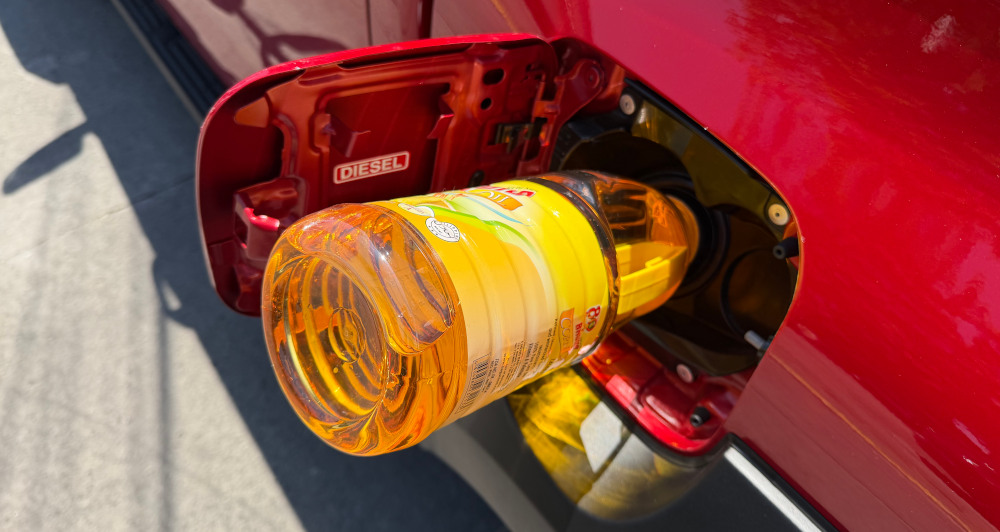

With gas and diesel prices through the roof and no definite end in sight to future increases, motorists are starting to explore ways to keep their fuel bills down that go beyond traditional fuel-saving tips. One of them is to circumvent the gas station completely and use much cheaper (often free) fuel, but does this potential king of all motoring life hacks really work?
When Rudolf Diesel first designed his famous engine back in 1893, the fuel by his name didn’t exist yet. Instead, the German inventor used vegetable and peanut oil to try out his patented “Neue, rationelle Wärmekraftmaschine” (new, rational heat-power machine), and part of his idea behind it was actually to enable farmers to make their own fuel. So, the short answer to the question in the headline is “yes, technically, diesel engines can run on vegetable oil,” but—and it’s a big BUT—before you now run out and drain the deep fryer of your local fast-food joint, there are a few things you need to consider.

For starters, vegetable oil and the diesel fuel that comes out of the pump are two very different things, and in general we can split everything up into three types of fuel that these engines will work on:
- WVO/UCO (waste vegetable oil/used cooking oil) – the raw stuff you could collect from carinderias and fast-food chains. It needs filtering and sometimes heating to be used as fuel directly.
- SVO (straight vegetable oil) – fresh, uncooked vegetable oil used as fuel directly.
- Biodiesel – vegetable oil that has undergone a chemical process called transesterification, which converts it into a fuel much closer in properties to petroleum diesel.
You’re using at least one of these on a regular basis already, and might not even realize it. The government has been pushing biodiesel blending for years, and the fuel you buy at the pump already contains a small percentage of coconut methyl ester (CME). Under Department Circular No. 2024-05-0014, all diesel fuels sold nationwide must contain a 3% CME blend from October 2024; 4% from October 2025; and 5% by October 2026. So, you’re technically already using biodiesel, albeit in small quantities as part of your normal fuel mix. It’s based on the Biofuels Act of 2006 that was designed to reduce dependence on imported oil, and looks like a great piece of foresight by the powers-that-be at the time.

But let’s get back to the most tempting proposition right now: using old cooking oil to power your car. Before you get too excited at the prospect of free fuel, the most important factor in this whole equation isn’t the oil. It’s what’s sitting under your hood. And this is where things get brutally simple: old engine, you’re in luck; new engine, walk away.
The diesels of yesteryear—your pre-2000 Isuzu Crosswind, old Toyota Hilux, Mitsubishi L300 with the 4D56 block, and old jeepneys running ancient Isuzu lumps (basically anything with glow plugs and a precombustion chamber)—were built with indirect injection (IDI) systems driven by mechanical in-line fuel pumps. They are robust, relatively simple, and importantly, tolerant of fuels with different viscosities. These engines were, in a very real sense, closer in spirit to what Herr Diesel originally envisioned. In the tropical climate around here—where ambient temperatures rarely dip below 25°C even at night—these old warriors will chew through properly filtered used cooking oil without much complaint.
Modern diesel engines are a completely different animal. Your current-generation Hilux, Montero Sport, Ranger, D-Max, and the like all run what’s called a common-rail direct injection system. These engines operate at insane injection pressures that can exceed 2,000 bar, and the tolerances inside the injectors are measured in microns. The ECU constantly monitors and adjusts fuel delivery with extreme precision. Pour thick, unprocessed cooking oil through that system and you are not saving money—you’re scheduling a very expensive trip to the casa. We’re talking injector replacements, fuel pump overhauls, and warranty voided on the spot. Don’t do it.

The biggest reason you can’t just pour oil straight into any diesel tank comes down to one word: viscosity. Cooking oil is significantly thicker than petroleum diesel. When fuel is too thick, it doesn’t atomize properly when it’s injected into the combustion chamber. The climate around here does help with this part, and keeps the fuel flowing a little more freely, but ideally it should be at 70°C or a little higher to really work well.
That’s why some people install two tank setups where normal diesel and cooking oil are stored in separate tanks in the car. You start driving on normal diesel, and when everything is warmed up, switch over to oil—with many setups also including a method to heat up the fuel line and make the oil flow more freely. That’s quite a bit of effort, but might be worth it if you’re daily-driving an older diesel and don’t fancy paying over a hundred pesos per liter for the pleasure.
This only leaves one final question: Is it legal to run your car on old cooking oil? The answer appears to be: It depends (and ask your own lawyer here, as this is neither mechanical nor legal advice). If you go all out and open a cooking oil fuel station in your neighborhood, then you’ll quickly find yourself in trouble as this would violate various rules and frameworks, such as the Biofuels Act of 2006. Private use, however, appears to be a bit of a gray area. The most likely violation is around air pollution. Plant oil fueling increases hydrocarbon emissions, slightly increases nitrogen oxide emissions, slightly decreases carbon monoxide emissions, increases opacity (particulate emissions), and slightly decreases carbon dioxide emissions. In short, you might not pass a smoke-belching test if the system has been set up wrong.
There are plenty of YouTube videos around on the topic, and a really good book called From the Fryer to the Fuel Tank if you want to dive deeper into the idea. Just do your research or ask a mechanic before attempting this.










Comments